I find myself struggling with figure counts. I recently had some success running an alt-history conquest of Mexico game at Hotlead 2026 using Dragon Rampant. The rules feel perfect for conventions. Units are 12 or 6 ‘strength points’, units toss 12 or 6 dice in combat, a 2D6 system governs orders. The game is quick to teach and everything a player needs can be fit on to a cue card per unit.
One of the things that made planning the game easier was the static nature of the unit strength points. It was easy to have all conquistador units comprise of 6 elite figures and all Mexica units comprise of 12 bellicose foot or light foot figures. The units felt appropriately sized and the game flowed well. It also meant I had an easier time of putting together armies of sufficient size on a budget. A single box of Wargames Atlantic Conquistadors gave me 4 units of elite foot. Two boxes of their Aztec gave me 5 units of 12. With a bit of 3D printing I was off to the races for a reasonable sum and things ‘felt’ right.
After the con, and after spending quite some money at the vendors and Bring and Buy, I wanted to turn my attention to my next project: The Anglo-Zulu War of 1879. This has been a project I’ve wanted to do since I first saw the 1964 film Zulu some 15 years ago. It’s taken time, but I finally have the ability and potential to dive in, but I am still restricted in time and funds, as we all are.
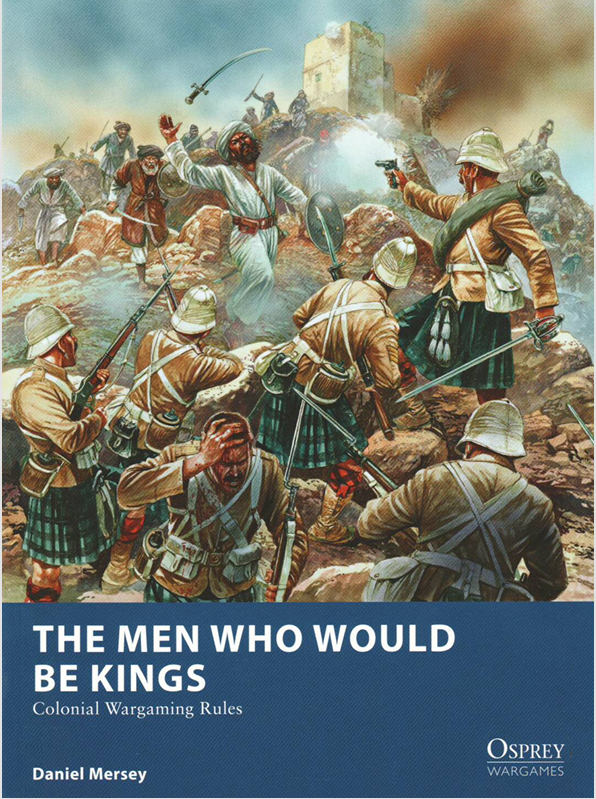
Liking the Dragon Rampant rules, I thought I would turn to The Men Who Would Be Kings (TMWWBK) for the kind of ‘large skirmish’ that I picture when I think of colonial engagements. However, digging in, I find the departure from the 12/6 strength points of Dragon Rampant and the 10/5 strength points of Xenos Rampant a little troubling. TMWWBK suggests every figure rolls a die, and that unit sizes reflect different types of units. My proposed Red Coats would take 12 men per unit, while my Zulus would take 16. 12 men I can handle. 16 puts me a bit at odds.
I’d bought Warlord Game’s Zulu starter army that contains 40 married and 40 unmarried Zulu warriors, and grabbed an additional 40 warriors from the bring and buy (with 20 more potential converts). With 16 figures per unit, I was looking at a grand total of 7 Zulu units. That may be decent, and looking at the suggested forces at the back of the book, a 24 point Zulu army consists of 6 units, but it felt a little much. At 12 men, I, with a box of Perry British and a box of Warlord British, would have 54 rankers, leaving me with 4 units of British. 4 would make 24 points at 6 points a model, but again it felt a little off to me. I began picturing 12 man Zulu units and considerably less British. 6 and 12 had served me well during the conquest of Mexico, but the combat rates were significantly different. I had to do some thinking.
I had much more at stake that just my Anglo-Zulu War. I had planned to use this ruleset as the basis for fighting the Boshin Civil War and Satsuma Rebellion as well as the Boxer War.
I had to do some math.
The ratios of men per unit between regular foot and tribal foot are 3:4. (12:16). If I wanted to reduce these units to squeeze out a few more maneuver units, and 10 Zulu units at 12 men per unit sounded nice, I would have to scale the rest of the game to match.
The ratio should technically slide down to 9:12, but this presented another critical problem. 9 men in two ranks doesn’t look great does it?
So what if the British were to sit at 8 men. They would be missing out on a single die in combat. How significant a problem would that be? Lets look at fighting output.
- Shooting:
- A British Unit (12 men) firing modern rifles at short range: 4 hits average.
- This reduces a Zulu unit from 16 to 12 men (25% losses, ouch!)
- A Modified British Unit (8 men) firing modern rifles at short range: 3 hits average ( 2.666 rounding)
- This reduces a Zulu unit from 12 to 9 men (25% losses, again ouch!)
- A British Unit (12 men) firing modern rifles at short range: 4 hits average.
- Morale:
- A 16 man Zulu unit receiving 25% losses (4 men) and testing for pinning: 8% rounding (These volleys are brutal aren’t they?
- The Zulu unit with an average leadership of 7+ and Discipline of 0+ needs to roll an 11 or 12 after suffering 4 losses from British fire (-4 from the 2D6 roll needing 7+)
- A 12 man Zulu unit receiving 25% losses (3 men) and testing for pinning: 17% rounding (This is double the full size unit’s odds)
- The smaller units on both sides do not affect the morale statistics of units. smaller units will therefore last comparatively longer.
- A 16 man Zulu unit receiving 25% losses (4 men) and testing for pinning: 8% rounding (These volleys are brutal aren’t they?
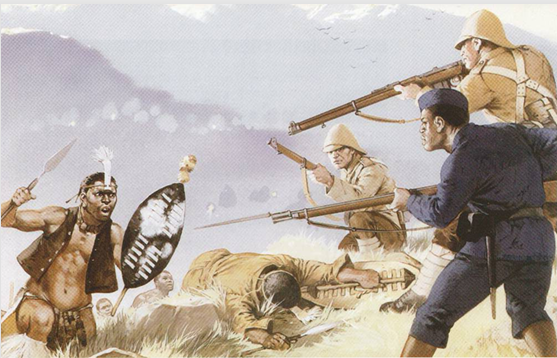
It seems I may have been a little too concerned. We average 25% casualties on a close range shot, and the reduction to the number of losses, though it will have an effect on morale. seems only to keep parties involved and fighting longer. This is something I can get behind. Looking through the book for additional rules, it really seems like I will just have to adjust Close Order. Close Order can be formed by 4 men in this reduced version, rather than the original 6. It remains the same ratio of 50% of the unit as before.
All Images from the MWWBK Rulebook by Peter Dennis
 News from the Tabletop